


Art and Science
_edited.jpg)
Original sample of a piece of Skytrain ice core drilled in West Antarctica in 2018. The enclosed air bubbles and the ice crystals (fine lines) that form with growing depth in the glacier ice are clearly visible. Sample size ca. 18mm x 50mm, age ca. 600 years
© Hoffmann
What is Art & Science?
You might think that science and art are so different in nature that they cannot form a connection. Where art is very subjective, shaped by emotions and feelings, science always strives for rationality and objectivity. And yet there are numerous touching points that go beyond the purely aesthetic presentation of scientific results.
Preserved snowflakes from the Arctic to Antarctica
"Art is not showing the obvious,
but making things visible" (Paul Klee)
Working and researching in polar regions, these special environments still fascinate us. The beauty of nature, its transience and perfection. We try to capture this amazement in art objects and thus pass on our fascination to other people. In our perception, art is thus both a way of communicating science and an expression of our personal enthusiasm for the beauty of the polar regions, glaciers, snow crystals and ice.
Let yourself be enchanted by delicate snowflakes, old ice and a frozen world that remains hidden for most people.

Highly transparent preserved ice crystal from Antarctica. Collected during the summertime at Neumayer-Station 2026

Snowflake from Antarctica. Collected during the Polarstern science cruise Bremerhaven / Neumayer 2021

Snowflake from the Arctic. Collected during the MOSAiC expedition near the North Pole 2019-2020
Highly transparent preserved ice crystal from Antarctica. Collected during the summertime at Neumayer-Station 2026

The Idea
What motivates us to combine science and art
Nature creates many unique and sometimes very fast-moving things on all scales. From mighty and bizarre-looking icebergs, fascinating crystal structures that grow in ice caves, to fragile snowflakes, which in turn are made up of thousands of individual crystals. Anyone who has ever tried to look at a snow crystal on their sweater or glove in winter knows how ephemeral these little beauties are. A breath of air is enough and they will break or thaw. It seems almost impossible to look at a real snowflake for longer than a few seconnds or even to be able to store it.
This is what happened to us at the beginning of our overwintering at Neumayer Station III in December 2017. Since then, we have been trying to find methods to preserve these unique structures. In principle, this is not a new idea. Starting already in the early 1960s, scientists tried to preserve snowflakes in the polar regions so that they could later be examined and categorized in the laboratory. However, usually with moderate success or only with enormous technical effort. We found a simple way to do it.
Our research areas are the cold and icy regions of the world. Through our work, we get in touch with the noticeable effects of climate change in these areas. We therefore see the delicate and fragile ice formations as a symbol of the transience and fragility of our planet. We would like to build a bridge between the hard facts of climate research and the ephemeral beauty of nature. We consider the artistic presentation as pathway not only to communicate the fascination of our work, but also to bring people closer to the sometimes uncomfortable truths of climate change.
In our projects and sculptures we work with real preserved snowflakes, ice crystals, ice samples and many other materials related to the polar regions and glaciers of this world. If possible, we also include all materials and devices related to our associated science and research. Many of our objects have a scientific background and tell stories that go beyond the pure aesthetics of ice crystals. You can always find details about the background in the description of the respective project.


Laser Lab University Cambridge and Cold Lab British Antarctic Survey
© Hoffmann 2021
How We Do It
We use four specially developed adhesive and fixation compounds that we have continuously refined over the past ten years. A key aspect of our work is the deliberate avoidance of methods that are harmful to human health and the environment, such as those commonly used in the 1960s. Instead, we rely on modern material technologies and innovative conservation techniques.
Each of our fixation compounds was designed for specific conservation processes and is additionally adapted individually to the physical and structural properties of the respective object. This enables us to preserve even highly sensitive and finely structured ice crystals and ice samples with precision and long-term stability.
Of central importance are the temperature range during the processing stage and the resulting viscosity of the fixation compound being used. These factors have a decisive influence on penetration behavior, stabilization, and the subsequent curing process. Equally critical is the chosen conservation method, as it determines both the reaction and curing times, as well as the possible use of a UV-curing component within the fixative.
Particularly in the case of extremely delicate and sensitive structures — such as ice crystals or ice samples that are several hundred thousand years old — the timing and sequence of the conservation process play a crucial role. Only through precisely coordinated procedures can such microscopic details be preserved visibly and permanently in their natural structure.
We work with imaging accuracy in the lower micrometer range (µm), allowing us to achieve an exceptionally high level of detail fidelity even within the smallest and most complex structures.
Depending on composition and mixing ratio, our fixation compounds can be specifically tailored to achieve a wide range of
material properties:
from soft and elastic to extremely hard
from internally blooming surfaces to highly transparent structures
weather-resistant and UV-resistant
and much more...
Our new highly transparent preservation method (as freshly fallen)

freshly fallen
Freshly fallen ice crystal on the tip of a scalpel
Lapland (Finland) 2025

preserved
Highly transparent preserved ice crystal Antarctica 2026

Highly transparent preserved ice crystal Antarctica 2026
Preservation with inward white crystallization

Preserved ice crystal
Lapland (Finland) 2025

Preserved ice crystal
Arctic sea 2019

Preserved ice crystal
Antarctica 2018
Transparent preserved sample of a 400'000 year old ice core

How we work


Set-up for the preservation of snow crystals
© Hoffmann 2021-23


Snowflake gallery from various expeditions
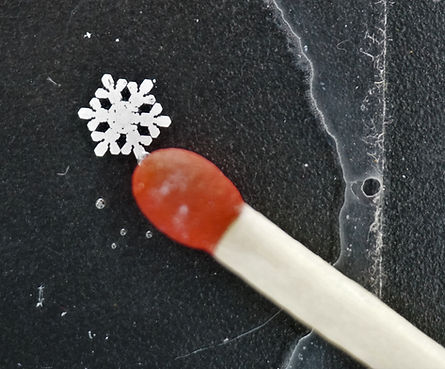
Size comparison: snowflake VS match
Preserved snowflakes from the Polarstern Cruise PS123

collected in the Weddel Sea on Polarstern during the crossing PS123 Bremerhaven-Neumayer 2021

collected in the Weddel Sea on Polarstern during the crossing PS123 Bremerhaven-Neumayer 2021
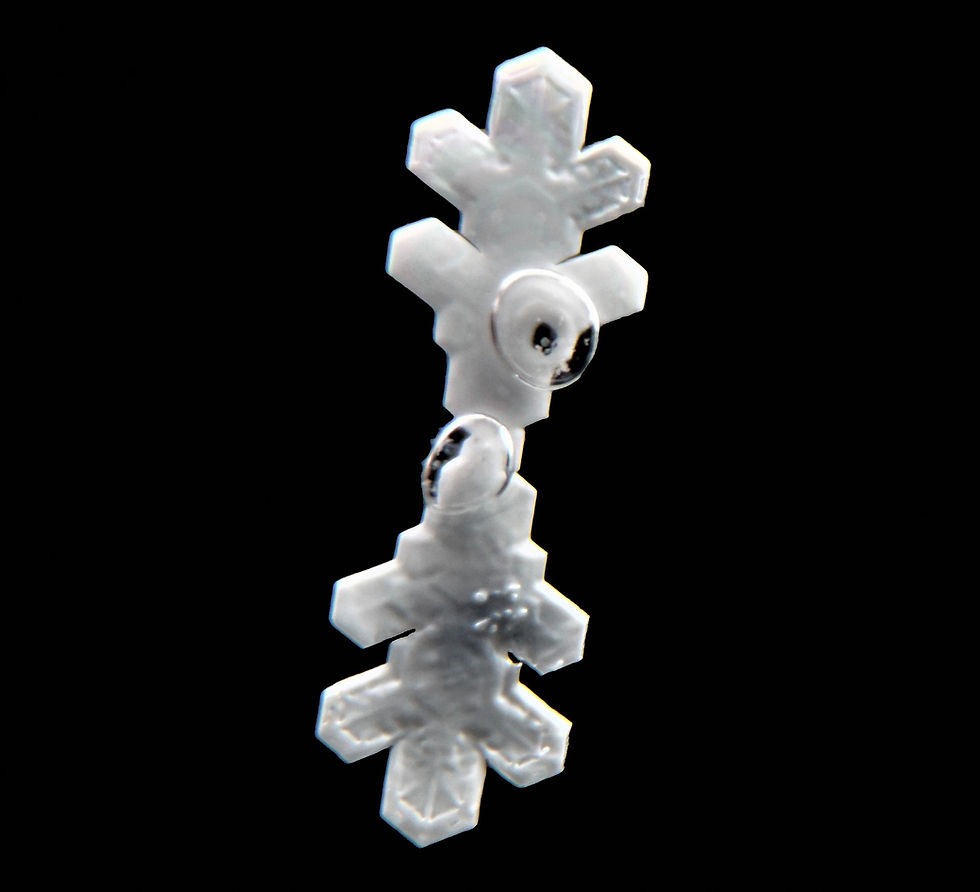
collected in the Weddel Sea on Polarstern during the crossing PS123 Bremerhaven-Neumayer 2021
collected in the Weddel Sea on Polarstern during the crossing PS123 Bremerhaven-Neumayer 2021
Preserved snowflakes from the Arctic winter

collected during the first leg of the MOSAiC expedition near the North Pole

collected during the first leg of the MOSAiC expedition near the North Pole

collected during the first leg of the MOSAiC expedition near the North Pole
collected during the first leg of the MOSAiC expedition near the North Pole
Original size of the snowflakes

Preserved snowflakes from the Antarctic summer

collected during the summer season at Neumayer 2021

collected during the summer season at Neumayer 2021

collected during the summer season at Neumayer 2021
collected during the summer season at Neumayer 2021
Preserved snowflakes from the Antarctic winter

Snowflake from the Antarctic winter collected at Neumayer Station III

Snowflake from the Antarctic winter collected at Neumayer Station III

Snowflake from the Antarctic winter collected at Neumayer Station III
Snowflake from the Antarctic winter collected at Neumayer Station III
Preserved snowflakes from the Austrian Alps

Snowflake from the Austrian Alps, collected at Woellaner Nock / Arriach February 2022

Snowflake from the Austrian Alps, collected at Woellaner Nock / Arriach February 2022

Snowflake from the Austrian Alps, collected at Woellaner Nock / Arriach February 2022
Snowflake from the Austrian Alps, collected at Woellaner Nock / Arriach February 2022


The formation of a snowflake

The formation of a snow crystal always starts with the right atmospheric conditions. Temperature and humidity must be in the right relation and there must be a nucleus. For example mineral dust, soot particles or biological material (aerosols), which serve as catalysts for the phase change (transition of the supercooled water to ice), can serve as ice nuclei. If it is cold enough (below -38 ° C), as in the polar regions, snow crystals can even form without aerosols or particles.
Depending on which air, temperature and cloud layers the crystals pass through on their way to the ground, they can form a multitude of different shapes. In dry air, prisms and platelets are more likely to develop, from which subsequently the typical snowflake shapes as one imagines can grow. The characteristic hexagonal shape of snow crystals results from the optimised arrangement of the water molecules when they freeze.
There are currently around 108 types of categorised snow crystals. And yet each crystal is as unique as a fingerprint and shows minimal differences on closer inspection. On their way through the cloud layers the individual snow crystals lock into each other and finally snowflakes are formed. They can reach the size of walnuts. But that only happens at temperatures around 0°C. Individual crystals that reach the earth's surface undamaged are true rarities.
Categorisation of snow crystals after Kikuchi et al. 2013 (Atmospheric Research)

Ukichiro Nakaya (1954, Harvard University Press)
Set-up for the preservation of snow crystals
© Hoffmann


Couple preserves snowflakes from Antarctica and the Arctic
https://www.weltkunst.de/kunstwissen/2025/07/paar-verewigt-schneeflocken-aus-antarktis-und-arktis

Unusual souvenirs: This couple preserves snowflakes from the polar regions
https://www.geo.de/wissen/dieses-paar-konserviert-schneeflocken-aus-den-polargebieten-35933936.html


Expedition into a disappearing world
August, 2022
CONTACT
Do you have questions about us, our projects or our science?
We are looking forward to your message!

Where are we mentioned:
Cryosity - Art and Science / copyright Helene and Thomas Hoffmann 2021-26


Please note that all images and texts published here are subject to the copyright and property of Helene and Thomas Hoffmann and may not be used without written permission.